Key Takeaway: JSGBETF is Pakistan's only sector-specific banking ETF. By holding a basket of the country's most profitable commercial banks, it is a high-dividend, value-oriented play, though it lacks diversification outside the banking sector.
The JS Global Banking Sector Exchange Traded Fund (JSGBETF) is unlike any other ETF on the Pakistan Stock Exchange (PSX). It is Pakistan's first ETF launched by a brokerage firm and the only fund tracking an equal-weighted commercial banking index. Over the past year, it delivered a +96.98% market price return, the strongest one-year performance of any listed ETF in Pakistan.
As of 2026-08-11, JSGBETF trades at PKR 42.72 per unit, at a -0.23% to iNAV to its live Net Asset Value (iNAV) of PKR 40.84. The fund holds 8.58 million units with total assets of PKR 351.5 million. Its 52-week range of PKR 27.43 to PKR 53.35 tells you everything about the volatility you are signing up for.
This independent review cuts through the marketing to show you what you actually own, how much the tracking gap really costs, and whether JSGBETF belongs in your portfolio in 2026.
What is JSGBETF? JS Global Banking Sector ETF Explained
JSGBETF is a sector exchange-traded fund that holds all eight commercial banks listed on the PSX in equal proportions. You buy one ticker. You get instant exposure to BOP, NBP, HBL, BAFL, BAHL, UBL, MCB, and Meezan Bank - each carrying an identical weight.
The fund was established on 30 January 2023 under the Sindh Trust Act 2020 and listed on the PSX on 11 September 2023. It is managed by JS Global Capital Limited, which became Pakistan's first brokerage firm to receive an asset management mandate under the SECP Regulatory Sandbox Guidelines of 2019. The trustee is CDC Pakistan Limited and the auditor is Grant Thornton.
For investors, this structure means one key thing: you do not need to pick which bank will outperform. You own all of them, and the fund automatically rebalances them back to equal weight every six months.
JSGBETF Key Metrics & Live PSX Data (June 2026)
| Metric | Value | Context |
|---|---|---|
| Full Name | JS Global Banking Sector Exchange Traded Fund | Pakistan's only pure commercial banking ETF |
| Ticker | JSGBETF | Listed on PSX under equity sector funds |
| Launch Date | 11 September 2023 | First brokerage-managed ETF in Pakistan |
| Fund Manager | JS Global Capital Limited | SECP Sandbox mandate - first of its kind |
| Benchmark | JS Global Banking Sector Index (BKTi) | Equal-weighted commercial banking index |
| AUM | PKR 374.5 million | As of 2026-07-27 |
| NAV (iNAV) | PKR 42.82 per unit | Live iNAV as of 2026-08-11 |
| iNAV as of 2026-07-27; published intraday by PSX | ||
| Market Price | PKR 42.72 per unit | As of 2026-08-11 (-0.23% to iNAV) |
| PSX Ticker Page | JSGBETF on PSX | View live intraday NAV, market price, and trading volumes |
| 52-Week Range | PKR 22.05 - PKR 53.35 | A 141% spread - this fund moves hard |
| Management Fee | 0.80% per annum | Base fee on average daily net assets |
| Total Expense Ratio (TER) | 2.50% per annum | The highest TER of any PSX ETF |
| Constituent Banks | 8 Commercial Banks | BOP, NBP, HBL, BAFL, BAHL, UBL, MCB, MEBL |
| Index Weighting | Equal-weighted (12.5% each) | Rebalanced every February and August |
Two facts stand out immediately. First, this fund is run by a brokerage firm, and not a traditional asset manager which is a structural first in Pakistan. Second, the 2.50% TER is the highest fee on the PSX. Every rupee of that fee comes out of your return every single year.
The Equal-Weight Edge: Why It Matters
Most equity indices are market-cap weighted. The biggest companies get the biggest weights. In a banking ETF, that would put HBL, MCB, and Meezan Bank at 50%+ of the fund, leaving smaller banks like BOP and NBP with tiny allocations.
JSGBETF does the opposite. Every bank starts at exactly 12.5%, reset to that level every six months.
What equal-weighting actually does for you:
- Buys cheap, trims expensive: At each rebalance, the fund sells banks that have rallied hard and buys banks that have lagged. It is a built-in "buy low, sell high" discipline.
- Gives BOP and NBP real weight: State-owned banks that trade at deep discounts to book value get the same allocation as premium franchise banks like MCB and Meezan. When sentiment shifts, these value names can re-rate sharply.
- Removes concentration risk: No single bank failure can devastate the portfolio.
- Creates higher turnover: All that buying and selling comes at a cost - it is one reason for the high 2.50% TER.
The equal-weight strategy is genuinely differentiated in Pakistan. No other PSX ETF does this. It is the right structure for investors who want to bet on the banking sector without betting on a single name.
Performance: The Real Numbers
The headline return of +96.98% in one year is the strongest performance of any listed ETF in Pakistan. But performance alone does not tell the full story.
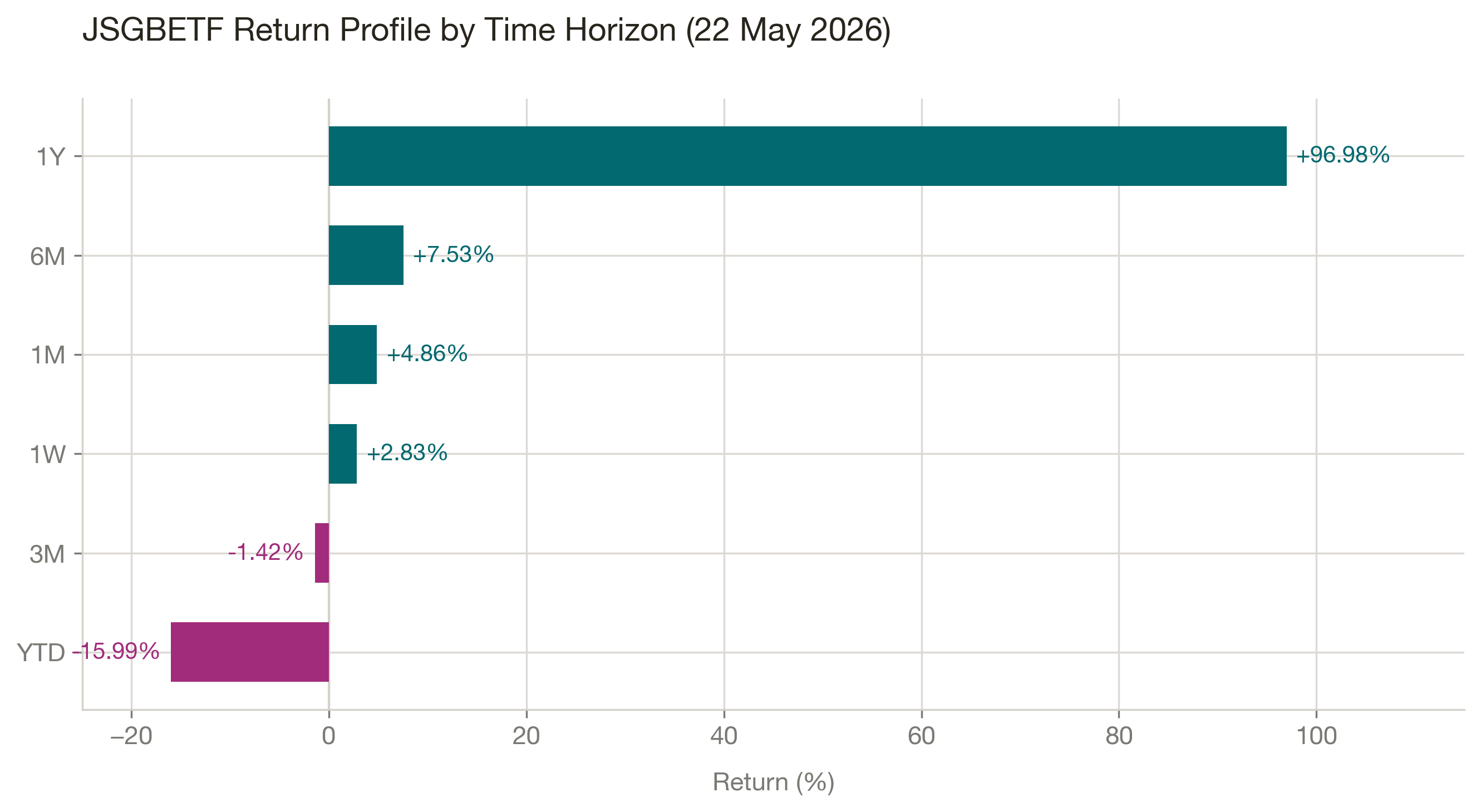
| Horizon | Market Price Return | NAV Return | Benchmark Return | Tracking Gap |
|---|---|---|---|---|
| 1 Week | +2.83% | +2.80% | +2.95% | -0.15pp |
| 1 Month | +4.86% | +4.86% | +5.12% | -0.26pp |
| 3 Months | -1.42% | -13.66% | -19.50% | +5.84pp (NAV leads) |
| 6 Months | +7.53% | -5.91% | -7.20% | +1.29pp (NAV leads) |
| 1 Year | +96.98% | +72.53% | +100.00% | -27.47pp (Index leads) |
| YTD | -15.99% | -8.00% | -20.00% | +12.00pp (NAV leads) |
| Since Launch | +288.20% | +240.00% | +580.00% | -340.00pp (Index leads) |
Performance data as of 2026-07-27. Source: JS Global Capital Limited / PSX. Past performance is not a guarantee of future results.
Understanding the Two Performance Gaps
Two gaps you must understand to get a clear picture of this ETF.
Gap 1 - Market Price vs. NAV (1Y)
The market price rose +96.98% while the fund's NAV rose only +72.53%. This means the ETF traded at a sustained premium over the past year. Investor demand for banking exposure was so high that buyers were willing to pay more than the fund's actual asset value. If you bought at the peak premium and sold at a smaller premium - or a discount - you would have underperformed the NAV return.
Gap 2 - NAV vs. Benchmark (Since Launch)
The benchmark returned 580% since September 2023. The ETF NAV returned 240%. The 340-percentage-point gap sounds alarming. It has two main causes:
- Cash Dividends: JSGBETF distributed PKR 40.92 per unit in cash since launch. The benchmark is a total-return index - it assumes all dividends are instantly reinvested. The ETF does not do this; it sends the cash to you. When you account for the dividends, the gap narrows significantly.
- Fee Drag: The 2.50% annual TER silently eats away at your returns every single day. Over 2.5 years, this compounds into a meaningful performance deficit.
JSGBETF Holdings: The Eight Equal-Weighted Commercial Banks
The fund holds eight commercial banks at equal weight, covering the full spectrum of Pakistani banking - from value-priced state-owned names to premium private-sector franchises.
| Symbol | Bank | Price (PKR) | P/E | P/B | Sector |
|---|---|---|---|---|---|
| BAFL | Bank Alfalah | 62.04 | 5.37 | 0.89 | Other Sectors |
| BAHL | Bank AL Habib | 177.99 | 5.89 | 1.06 | Other Sectors |
| BOP | Bank of Punjab | 36.77 | 4.41 | 0.85 | Other Sectors |
| HBL | Habib Bank | 313.78 | 5.50 | 0.80 | Other Sectors |
| MCB | MCB Bank | 426.84 | 7.65 | 1.38 | Other Sectors |
| MEBL | Meezan Bank | 557.70 | 8.94 | 2.87 | Islamic Bank |
| NBP | National Bank | 210.57 | 4.52 | 0.82 | Other Sectors |
| UBL | United Bank | 490.77 | 5.84 | 1.97 | Other Sectors |
Equal-Weighted Average P/E: ~6.01x | Equal-Weighted Average P/B: ~1.33x
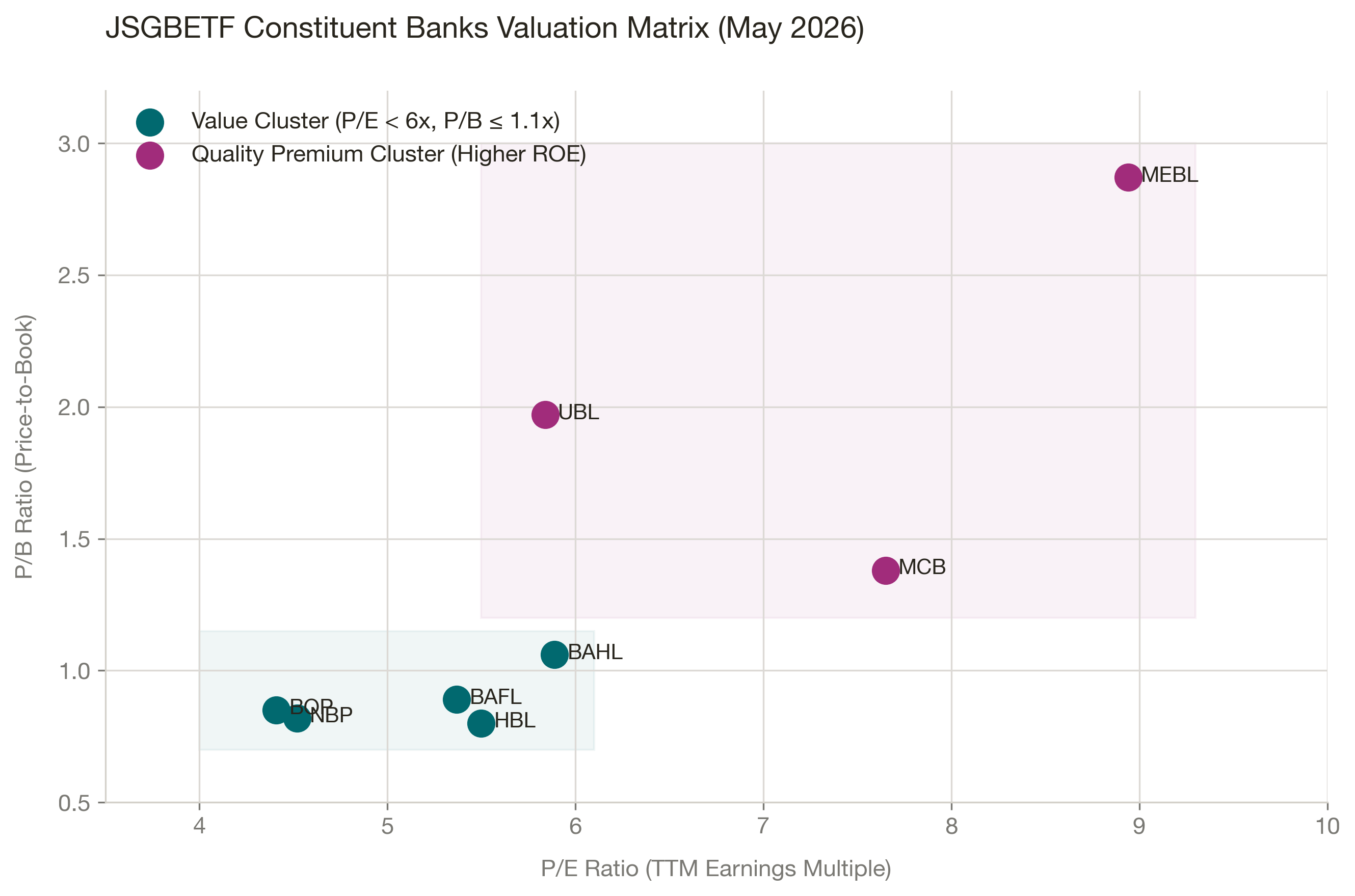
A quick look at the valuation data reveals two very different groups inside this fund:
The Value Cluster (P/E 4-6x, P/B under 1.1x): BOP, NBP, HBL, Bank Alfalah, and Bank AL Habib. BOP and NBP trade at or below their book value because markets discount state ownership risk. HBL at 5.50x P/E and 0.80x P/B is arguably the best risk-to-reward ratio in the basket for a major private bank.
The Quality Premium Cluster (P/E 7-9x, P/B 1.4-2.9x): MCB, Meezan Bank, and UBL. MCB trades at a premium for its consistently high return on equity and strong dividend history. Meezan Bank commands the highest multiple as Pakistan's dominant Islamic bank. UBL sits in the middle with improving earnings momentum.
The equal-weight payoff: In any cap-weighted fund, MCB and Meezan would own the portfolio. Equal-weighting forces a 12.5% allocation into BOP and NBP - the names with the sharpest re-rating potential when banking sentiment recovers.
JSGBETF Dividend History: All Payouts Since Launch
JSGBETF has made three cash distributions in less than three years. For a fund this young, that is a compelling income track record.
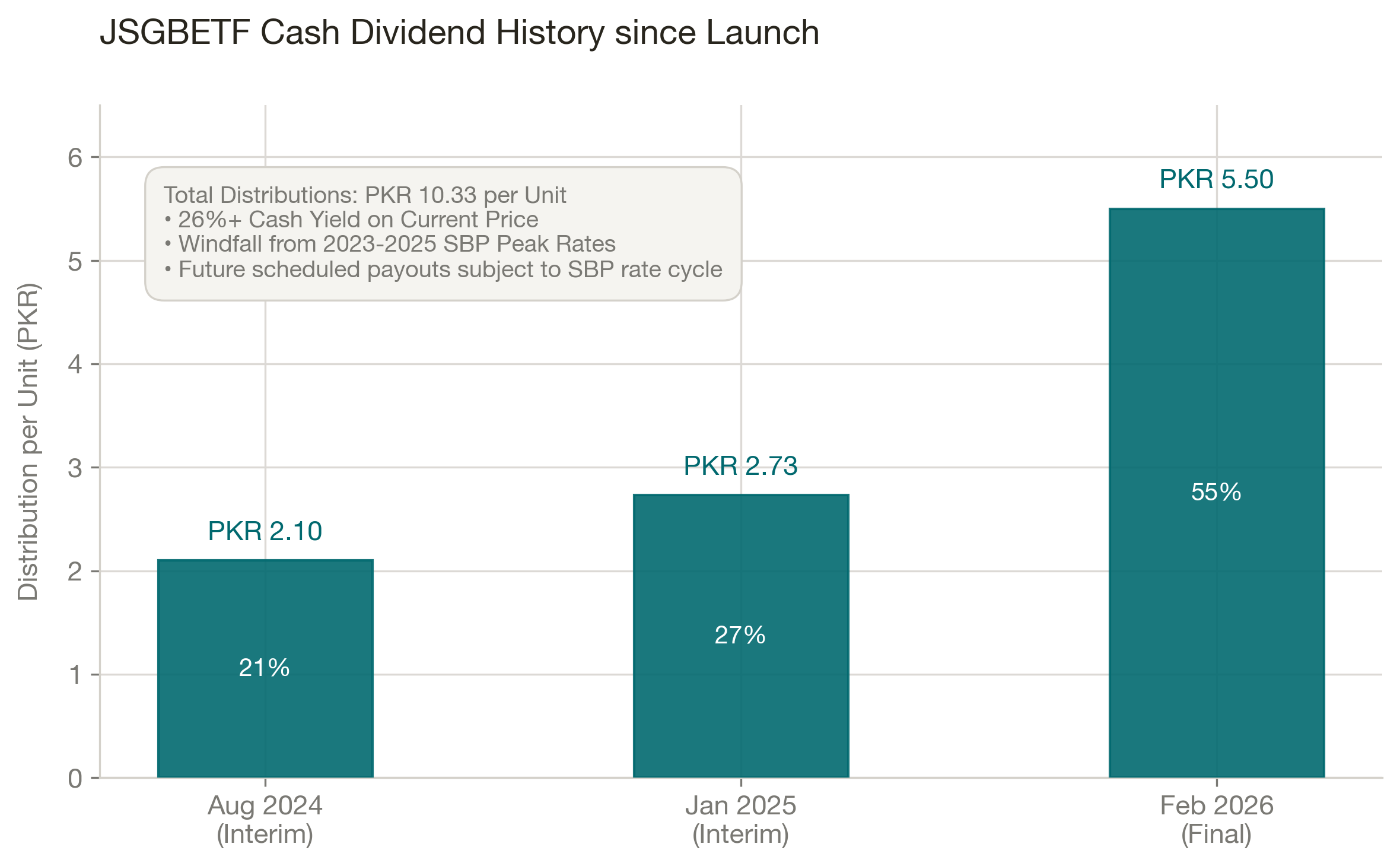
| Date | Type | % of Face Value | PKR per Unit | Book Closure |
|---|---|---|---|---|
| 23 August 2024 | Interim | 21.04% | PKR 2.10 | September 2024 |
| 9 January 2025 | Interim | 27.32% | PKR 2.73 | 13-14 January 2025 |
| 25 February 2026 | Final | 55.00% | PKR 5.50 | 26 Feb - 3 Mar 2026 |
Total cash paid since launch: PKR 40.92 per unit.
The February 2026 payout of PKR 40.92 per unit was exceptional. An investor who bought near the 52-week low of PKR 22.05 and held through to February 2026 received a 25%+ cash yield on cost from a single dividend.
Why were dividends so large? Pakistani banks earned record profits when the State Bank held interest rates at 22% between 2023 and early 2025. Banks earned massive spreads by taking in cheap deposits and parking them in high-yield government T-bills. JSGBETF collected those dividends and passed them directly to investors.
What happens next? Interest rates are falling in 2026. Bank margins will shrink. The 55% final dividend of February 2026 will not repeat. However, as private lending grows, banks remain highly profitable. Annual dividend yields of 20-30% are still achievable - just not at February 2026 levels.
NAV vs Benchmark: Three Charts, One Story
These three charts show how JSGBETF's NAV performed against its benchmark across three time horizons. The teal line is the ETF NAV. The gold line is the index. The gap between them is what you give up by owning the fund instead of the index directly.
YTD: The Fund Protects You in a Downturn
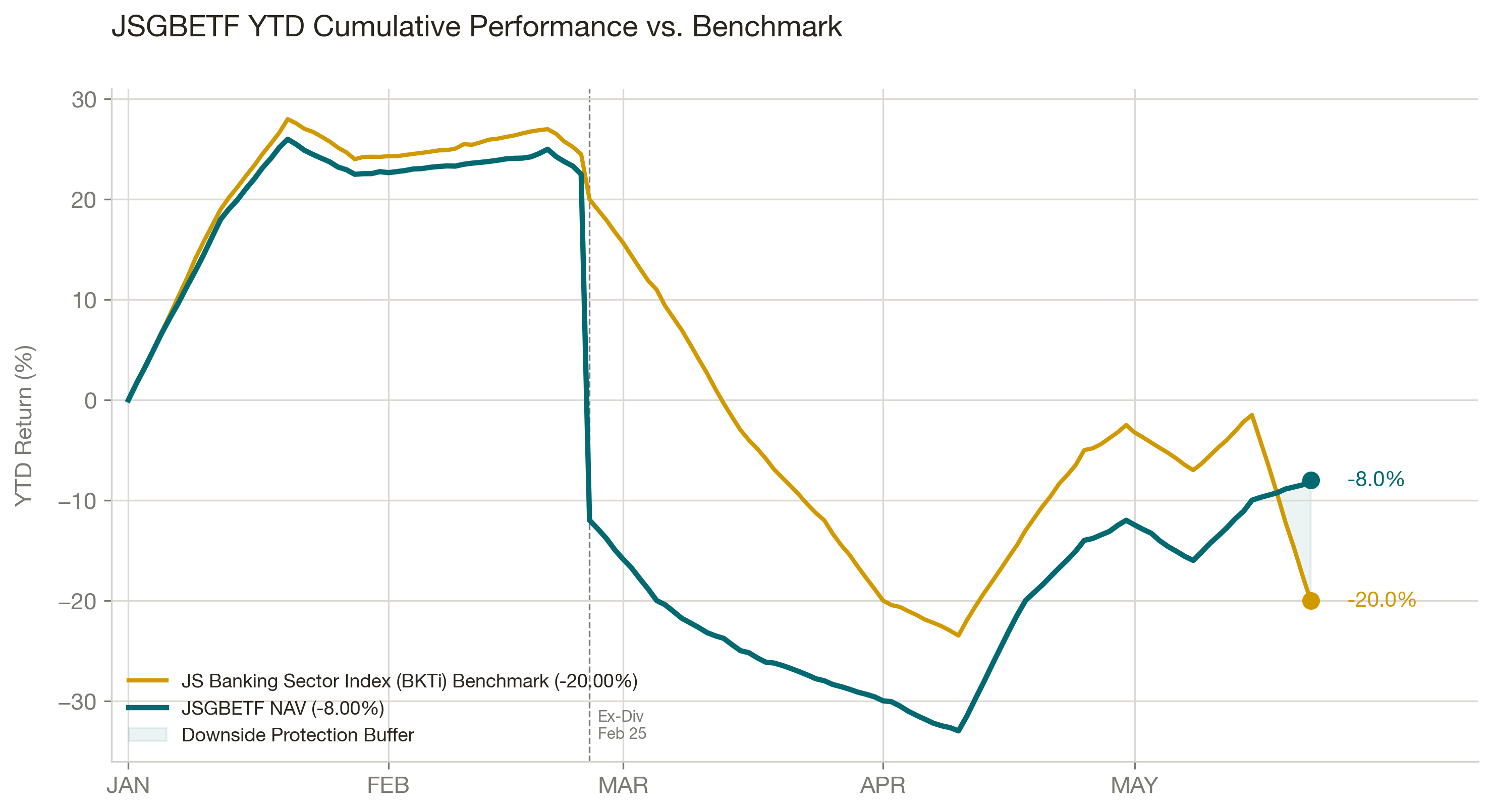
YTD, the benchmark has fallen -20.00% while the ETF NAV has fallen only -8.00%. The fund is outperforming its index by +12 percentage points in a declining market. Why? The cash buffer from the February 2026 dividend payout and the February rebalancing gave the fund a cushion that the index does not have.
This is when equal-weighting earns its keep.
1 Year: The Bull Run Tax
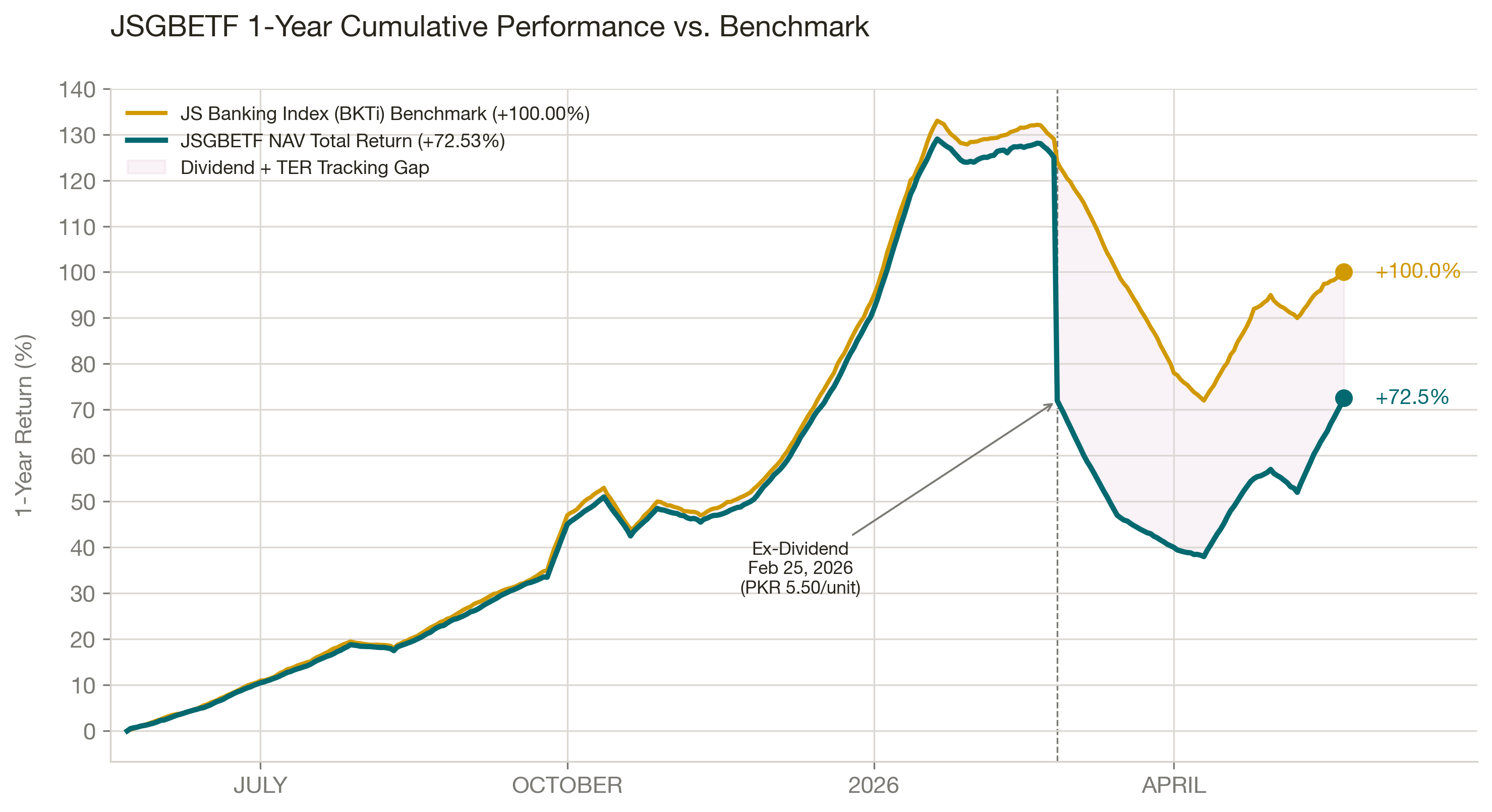
Over the past year, the index rose +100.00% while the ETF NAV rose +72.53%. The fund trailed by 27.47 percentage points. The main culprit: equal-weight rebalancing caps any single winner at 12.5%. When a few banks rally far ahead of the pack - as happened in 2024 and 2025 - the ETF systematically sells those winners. The index keeps holding them. The index wins.
This is the structural cost of equal-weighting in a strong bull market.
Since Launch: The Full Picture
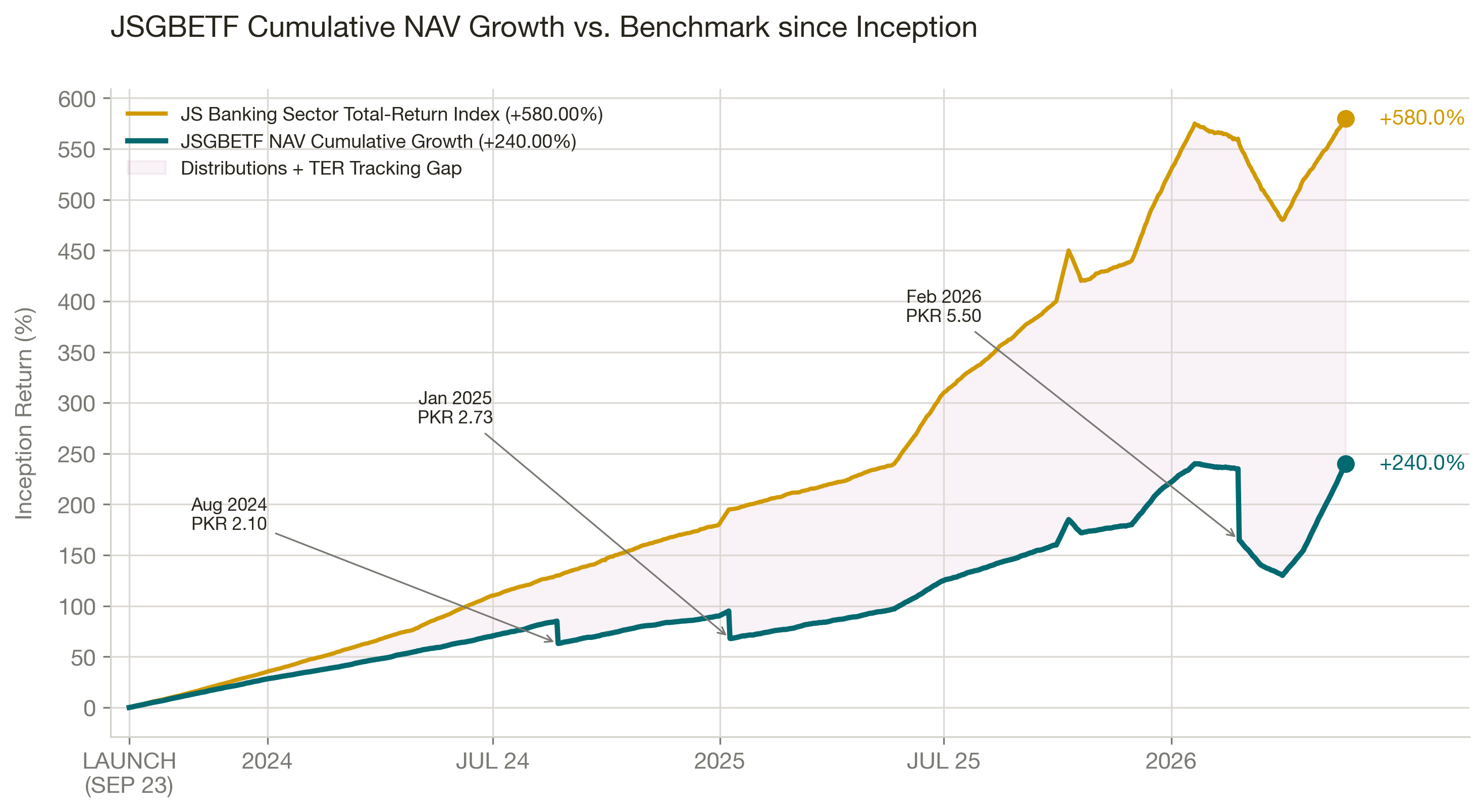
Since September 2023, the benchmark has returned +580.00% while the ETF NAV has returned +240.00%. But before you panic, add back the PKR 40.92 per unit paid out in cash. When you include those dividends, the total return to investors closes the gap considerably. The remaining difference is the fee drag and the equal-weight rebalancing cost during an exceptional bull run.
What the Tracking Gap Actually Costs: A Real Rupee Example
Imagine you invested PKR 1,000,000 at the fund's launch in September 2023.
| Scenario | Ending Capital Value | Notes |
|---|---|---|
| Direct Index (zero cost) | PKR 6,800,000 | Assumes zero fees and instant dividend reinvestment |
| ETF Capital Appreciation | PKR 3,400,000 | NAV +240% on original investment |
| Cash Dividends Received | PKR 1,033,000 | PKR 40.92 per unit x 100,000 units |
| Total ETF Outcome | PKR 4,433,000 | Capital + dividends = +343% total return |
The gap: PKR 6,800,000 (index) versus PKR 4,433,000 (ETF) = PKR 2,367,000 difference.
Most of that gap comes from taking cash dividends instead of reinvesting them. The 2.50% annual fee accounts for the rest. This is not a scam - it is how the product is designed. Know this before you invest.
Rebalancing and Reporting: Structural Advantages
JSGBETF has rebalanced on schedule every six months since launch. This is not trivial - consistency here matters.
| Date | Event |
|---|---|
| February 2024 | First semi-annual rebalancing - weights reset to 12.5% |
| August 2024 | Mid-year rebalancing - coincided with PKR 2.10 interim dividend |
| January 2025 | PKR 2.73 interim dividend paid |
| February 2025 | Semi-annual recomposition |
| August 2025 | Mid-year rebalancing |
| February 2026 | Full recomposition + PKR 5.50 final dividend |
| April 2026 | Q1 2026 financials filed directly with PSX |
The fund files quarterly and annual financial reports directly with the PSX. This real-time disclosure is a genuine advantage that reduces information risk. You always know what you own.
Is JSGBETF Right for You?
Let me address the fee issue directly: 2.50% TER is the highest on the PSX, and for a passive, index-tracking product that is very hard to justify on a permanent basis. Every year you hold JSGBETF, the fee takes 2.50% off your return before you receive a single rupee. Over a decade of Pakistan's historical equity returns, that compounds into a meaningful wealth loss versus owning the same banking stocks directly or through a lower-cost vehicle.
That said, JSGBETF does something no other PSX ETF does: it gives you pure, equal-weighted exposure to Pakistani commercial banking stocks in a single regulated instrument, with intraday liquidity and CDC settlement. If you have a tactical view that Pakistan's banking sector will re-rate strongly - falling NPLs, rate cycle recovery, credit growth and you want to express that view through a structured product rather than picking individual bank stocks, JSGBETF is the tool.
My recommendation: JSGBETF is a tactical instrument, not a core holding. Use it for a specific time-bound thesis on Pakistan's banking sector with a clear exit in mind. If you cannot articulate why you expect banking to outperform by at least 3% above the broader market - enough to absorb the fee drag - you should not own this fund. Long-term passive investors should look at NBPGETF or UBLPETF instead, both of which include bank exposure at a fraction of the cost.
Final Verdict
JSGBETF is a powerful tactical tool, not a buy-and-hold forever fund.
It gives you the cleanest, most liquid way to trade the Pakistan banking cycle with one ticker. The equal-weight structure is genuinely innovative and provides a differentiated risk profile versus cap-weighted alternatives. The dividend track record is exceptional - PKR 40.92 per unit in under three years is hard to ignore.
But the 2.50% TER is a serious problem for long-term investors. Combined with equal-weight rebalancing drag in bull markets, the fund will consistently trail its benchmark when banking stocks are rising fast.
Our recommendations:
- For Income Seekers (Buy): This is one of the best cash-paying assets on the PSX. The dividend yield is real, the distributions are consistent, and the banking sector remains profitable even as rates fall. Just accept that future dividends will be lower than the exceptional 2026 payout.
- For Tactical Investors (Buy with a Plan): Use JSGBETF as a satellite position alongside a broad market fund like MZNPETF or MIIETF. You get diversified market exposure as your core, with a high-yield banking booster on top.
- For Long-Term Passive Investors (Caution): The 2.50% fee is difficult to justify if your goal is to track the market efficiently over a decade. At that time horizon, consider buying the eight underlying bank stocks directly and rebalancing yourself - or see how JSGBETF stacks up against every alternative in the Best ETF in Pakistan 2026 ranking.
Analyze This ETF
Frequently Asked Questions (FAQs)
What is JSGBETF?
JSGBETF is the JS Global Banking Sector Exchange Traded Fund, listed on the Pakistan Stock Exchange. It holds eight commercial banks - BOP, NBP, HBL, BAFL, BAHL, UBL, MCB, and Meezan Bank - each at an equal 12.5% weight. It is Pakistan's first brokerage-managed ETF and the only fund tracking an equal-weighted banking index.
What is the minimum investment for JSGBETF?
The minimum trade on the PSX is 500 units. At the current market price of PKR 42.78, the minimum entry is approximately PKR 21,390, excluding brokerage commissions and taxes.
Why is JSGBETF's TER so high at 2.50%?
The 2.50% TER (which includes the 0.80% management fee) reflects several cost layers: the 0.80% base management fee, trustee fees to CDC Pakistan, audit fees to Grant Thornton, SECP levies, and the transaction costs of semi-annual equal-weight rebalancing. Rebalancing eight stocks every six months generates brokerage fees and market impact costs that get absorbed into the TER. As the fund's AUM grows, this ratio should decline.
Why does JSGBETF have such a large tracking gap versus its benchmark?
Two primary reasons:
- Cash dividends: The fund has paid PKR 40.92 per unit in cash since launch. The benchmark index is a total-return index - it assumes all dividends are reinvested immediately at zero cost. The ETF cannot do this; it distributes cash to investors. When you add back the dividends, the true gap narrows significantly.
- Fee drag: The 2.50% annual TER creates a persistent, compounding performance deficit versus the zero-cost benchmark.
How often does JSGBETF rebalance?
The portfolio is rebalanced semi-annually in February and August. All eight bank weights are reset to 12.5% at each rebalancing. The February rebalancing typically coincides with the annual dividend distribution.
Will JSGBETF pay dividends again in 2026?
The February 2026 distribution of PKR 40.92 per unit was exceptional - driven by record bank profits during the high interest rate period. As the State Bank of Pakistan lowers rates in 2026, bank margins will compress. Future dividends are likely to be smaller than the 2026 payout. However, Pakistani banks remain highly profitable and regular dividend distributions are expected to continue.
Should I choose JSGBETF or a broad market ETF like MIIETF?
JSGBETF is a sector ETF - it is highly concentrated in 8 commercial banks. MIIETF and MZNPETF hold 30 and 12 diversified Shariah-screened stocks respectively. JSGBETF is best used as a tactical satellite (5-15% of your portfolio), not a core holding. It also has a 2.50% TER - the highest of any PSX ETF.
Is JSGBETF better than a mutual fund investing in banks?
For pure banking sector exposure, JSGBETF is transparent (daily holdings disclosure), intraday liquid, and cheaper than most active mutual funds targeting bank stocks. However, its 2.50% TER is high for an ETF.
Who manages JSGBETF?
The fund is managed by JS Global Capital Limited, a leading Pakistan securities brokerage. JS Global received a special sandbox asset management mandate from the SECP under its Regulatory Sandbox Guidelines of 2019, making it the first brokerage firm in Pakistan to launch and manage an ETF.
Can I buy JSGBETF through my regular broker?
Yes. JSGBETF is listed on the Pakistan Stock Exchange under the ticker JSGBETF. It can be bought or sold during normal PSX trading hours through any registered PSX brokerage account - the same way you would buy any listed share.
Who regulates JSGBETF?
The fund is regulated by the Securities & Exchange Commission of Pakistan (SECP) under the Collective Investment Schemes rules, and the units are safeguarded by the Central Depository Company of Pakistan (CDC).
Further Reading
Before investing in JSGBETF, we recommend reviewing the following resources:
- Understanding ETF Fundamentals - Learn how sector-concentrated ETFs amplify risk and return relative to diversified index funds.
- How to Invest in ETFs in Pakistan - A step-by-step guide to buying JSGBETF through any registered PSX brokerage account.
- All PSX ETFs Ranked: Best ETF in Pakistan - Understand where JSGBETF fits in the PSX ETF landscape by size, cost, and return.
- KSE-100 ETF Alternatives in Pakistan - Explore broader-market ETF options if the single-sector concentration of JSGBETF is too aggressive for your portfolio.
This article is for educational and informational purposes only. It does not constitute investment advice. Always conduct your own due diligence and consult a qualified financial advisor before making any investment decisions. All data sourced from PSX, MUFAP, and fund factsheets. Past performance is not indicative of future results.
Dr. Faisal Shahzad
Chief Investment Strategist
Dr. Faisal Shahzad holds an MBA from Innsbruck, Austria, and has spent over a decade navigating complex financial markets. He specializes in Exchange Traded Funds (ETFs) and brings extensive, practical knowledge of both international markets and the Pakistan Stock Exchange (PSX).
Expertise: 15+ Years of experience in ETFs, both internationally and on the PSX.
Explore JSGBETF With Our Free Tools
Go deeper on your analysis with institutional-grade analytics built specifically for PSX ETFs.